

Pass Your Microsoft Azure Administrator Associate AZ-104 Exam on May 24, 2024 with 322 Questions
AZ-104 Free Exam Study Guide! (Updated 322 Questions)
Main Topics and Subtopics of Microsoft AZ-104 Exam
There are a few different objectives included in the AZ-104 certification test, so the candidates will need to work hard on them. These topics cover the following areas:
- Monitor and Back Up Azure Resources (10-15%)
This subject area is designed to check the examinees’ knowledge and skills in the following areas: monitoring resources with the help of Azure Monitor (customizing and interpreting metrics; customizing Log Analytics; querying and analyzing logs; setting up actions and alerts; customizing Application Insights); implementing recovery and backup (customizing and reviewing backup reports; executing backup and restore operations with the help of Azure Backup; designing a Recovery Services Vault; designing and customizing backup policy; executing site-to-site recovery with the help of Azure Site Recovery).
- Manage and Configure Virtual Networking (30-35%)
In this topic, the candidates must confirm that they have expertise in implementing and managing virtual networking (designing and customizing VNET peering; customizing private and public IP addresses, subnets, network routes, virtual network, and network interface); customizing name resolution (customizing Azure DNS; customizing custom DNS settings; customizing a private or public DNS zone); securing access to virtual networks (designing security rules; associating an NSG to network interface or a subnet; assessing effective security rules; deploying and configuring Azure Firewall; deploying and customizing Azure Bastion Service); customizing load balancing (customizing Application Gateway; customizing an internal load balancer; customizing load balancing rules; customizing a public load balancer; fixing load balancing); monitoring and fixing virtual networking (monitoring on-premises connectivity; utilizing Network Performance Monitor; utilizing Network Watcher; fixing external networking; troubleshooting virtual network connectivity); integrating an on-premises network with an Azure virtual network (designing and customizing Azure VPN Gateway; designing and customizing VPNs; customizing ExpressRoute; customizing Azure Virtual WAN).
- Implement and Manage Storage (10-15%)
Within this domain, the applicants need to demonstrate the abilities, such as managing storage accounts (customizing network access to storage accounts; designing and customizing storage accounts; generating shared access signature; managing access keys; executing Azure storage replication; customizing Azure AD Authentication for a storage account); managing data in Azure Storage (exporting from Azure job; importing into Azure job; installing and utilizing Azure Storage Explorer; copying data with the help of AZCopy); customizing Azure files and Azure blob storage (designing an Azure file share; designing and customizing Azure File Sync service; customizing Azure blob storage; customizing storage tiers for Azure blobs).
- Deploy and Manage Azure Compute Resources (25-30%)
In the framework of this topic, the test takers are required to show that they have a grasp of the following skills: monitoring resources with the help of Azure Monitor (monitoring a network; customizing and interpreting metrics; customizing Log Analytics; querying and analyzing logs; setting up actions and alerts; customizing Application Insights); executing recovery and backup (customizing and reviewing backup reports; executing restore and backup operations with the help of Azure Backup; designing Recovery Services Vault; designing and customizing backup policy; executing site-to-site recovery with the help of Azure Site Recovery).
- Manage Azure Governance and Identities (15-20%)
This objective encompasses the following competencies: managing Azure Active Directory objects (designing users and groups; managing group and user properties; managing device settings; executing bulk user updates; managing guest accounts; customizing Azure AD Join; customizing self-service password reset); managing role-based access control (designing a custom role; accessing Azure resources through assigning roles; interpreting access assignments; managing multiple directories); managing governance and subscriptions (customizing Azure policies; customizing resource locks; applying tags; designing and managing resource groups; managing subscriptions; customizing Cost Management; customizing management groups).
NEW QUESTION # 135
You have an Azure virtual machine that runs Windows Server 2019 and has the following configurations:
Name: VM1
Location: West US
Connected to: VNET1
Private IP address: 10.1.0.4
Public IP address: 52.186.85.63
DNS suffix in Windows Server: Adatum.com
You create the Azure DNS zones shown in the following table.
You need to identify which DNS zones you can link to VNET1 and the DNS zones to which VM1 can automatically register.
Which zones should you identify? To answer, select the appropriate options in the answer area.
Answer:
Explanation:
Reference:
https://docs.microsoft.com/en-us/azure/dns/private-dns-overview
NEW QUESTION # 136
You have an Azure subscription that contains the storage accounts shown in the following exhibit.
Use the drop-down menus to select the answer choice that completes each statement based on the information presented in the graphic.
NOTE: Each correct selection is worth one point.
Answer:
Explanation: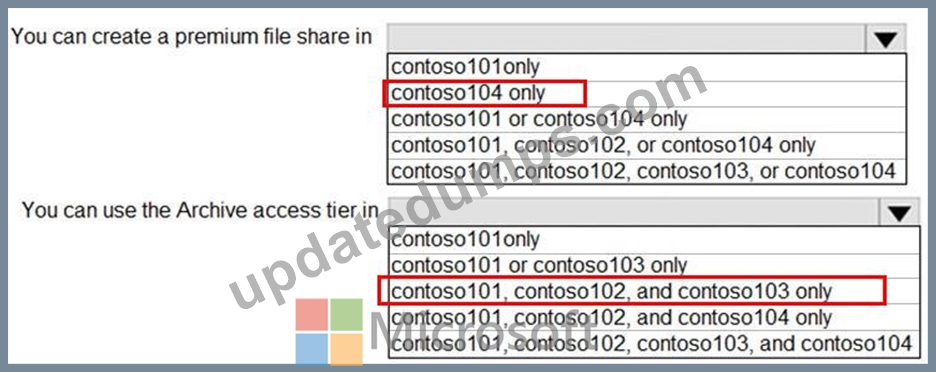
Reference:
https://docs.microsoft.com/en-us/azure/storage/files/storage-how-to-create-premium-fileshare?tabs=azure-portal
https://docs.microsoft.com/en-us/azure/storage/blobs/storage-blob-storage-tiers
NEW QUESTION # 137
Your network contains an on-premises Active Directory forest named contoso.com that contains two domains named contoso.com and east.contoso.com.
The forest contains the users shown in the following table.
You plan to sync east.contoso.com to an Azure Active Directory (Azure AD) tenant by using Azure AD Connect.
You need to select an account for Azure AD Connect to use to connect to the forest.
Which account should you select?
- A. User3
- B. User4
- C. User2
- D. User1
Answer: B
Explanation:
It is no longer supported to use an enterprise admin or a domain admin account as the AD DS Connector account.
Reference:
https://docs.microsoft.com/en-us/azure/active-directory/hybrid/reference-connect-accounts-permissions
NEW QUESTION # 138
You have an Azure subscription that contains an Azure Active Directory (Azure AD) tenant named adatum.com. The tenant contains 500 user accounts.
You deploy Microsoft Office 365. You configure Office 365 to use the user accounts in adatum.com.
You configure 60 users to connect to mailboxes in Microsoft Exchange Online.
You need to ensure that the 60 users use Azure Multi-Factor Authentication (MFA) to connect to the Exchange Online mailboxes. The solution must only affect connections to the Exchange Online mailboxes.
What should you do?
- A. From Azure Active Directory admin center, create a conditional access policy
- B. From the multi-factor authentication page, configure the Multi-Factor Auth status for each user
- C. From the Azure Active Directory admin center, configure an authentication method
- D. From the multi-factor authentication page, modify the verification options
Answer: B
Explanation:
Reference:
https://docs.microsoft.com/en-us/azure/active-directory/authentication/howto-mfa-userstates
NEW QUESTION # 139
You plan to create a new Azure Active Directory (Azure AD) role.
You need to ensure that the new role can view all the resources in the Azure subscription and issue support requests to Microsoft. The solution must use the principle of least privilege.
How should you complete the JSON definition? To answer, select the appropriate options in the answer area.
NOTE: Each correct selection is worth one point.
Answer:
Explanation:
Reference:
https://docs.microsoft.com/en-us/azure/role-based-access-control/tutorial-custom-role-powershell
https://docs.microsoft.com/en-us/azure/role-based-access-control/built-in-roles
NEW QUESTION # 140
Question: 153
Note: This question is part of a series of questions that present the same scenario. Each question in the series contains a unique solution that might meet the stated goals. Some question sets might have more than one correct solution, while others might not have a correct solution.
After you answer a question in this section, you will NOT be able to return to it. As a result, these questions will not appear in the review screen.
You have an Azure subscription named Subscription1. Subscription1 contains a resource group named RG1. RG1 contains resources that were deployed by using templates.
You need to view the date and time when the resources were created in RG1.
Solution: From the RG1 blade, you click Automation script.
Does this meet the goal?
- A. No
- B. Yes
Answer: A
Explanation:
From the RG1 blade, click Deployments. You see a history of deployment for the resource group.
Reference:
https://docs.microsoft.com/en-us/azure/azure-resource-manager/templates/template-tutorial-create-first-template?tabs=azure-powershell Through activity logs, you can determine:
* what operations were taken on the resources in your subscription
* who started the operation
* when the operation occurred
* the status of the operation
* the values of other properties that might help you research the operation
1. On the Azure portal menu, select Monitor, or search for and select Monitor from any page
2. Select Activity Log.
3. You see a summary of recent operations. A default set of filters is applied to the operations. Notice the information on the summary includes who started the action and when it happened.
https://docs.microsoft.com/en-us/azure/azure-resource-manager/management/view-activity-logs
NEW QUESTION # 141
You have the Azure management groups shown in the following table.
You add Azure subscriptions to the management groups as shown in the following table.
You create the Azure policies shown in the following table.
For each of the following statements, select Yes if the statement is true. Otherwise, select No.
NOTE: Each correct selection is worth one point.
Answer:
Explanation:
Reference:
https://docs.microsoft.com/en-us/azure/governance/management-groups/overview
https://docs.microsoft.com/en-us/azure/governance/management-groups/manage#moving-management-groups-and-subscriptions
NEW QUESTION # 142
You have an Active Directory forest named contoso.com.
You install and configure Azure AD Connect to use password hash synchronization as the single sign-on (SSO) method. Staging mode is enabled.
You review the synchronization results and discover that the Synchronization Service Manager does not display any sync jobs.
You need to ensure that the synchronization completes successfully.
What should you do?
- A. From Azure PowerShell, run Start-AdSyncSyncCycle -PolicyType Initial.
- B. Run Azure AD Connect and set the SSO method to Pass-through Authentication.
- C. From Synchronization Service Manager, run a full import.
- D. Run Azure AD Connect and disable staging mode.
Answer: D
Explanation:
Staging mode must be disabled. If the Azure AD Connect server is in staging mode, password hash synchronization is temporarily disabled.
References: https://docs.microsoft.com/en-us/azure/active-directory/connect/active-directory- aadconnectsync-troubleshoot-password-hash-synchronization#no-passwords-are-synchronized- troubleshoot-by-using-the-troubleshooting-task
NEW QUESTION # 143
You have an Azure subscription.
You create the Azure Storage account shown in the following exhibit.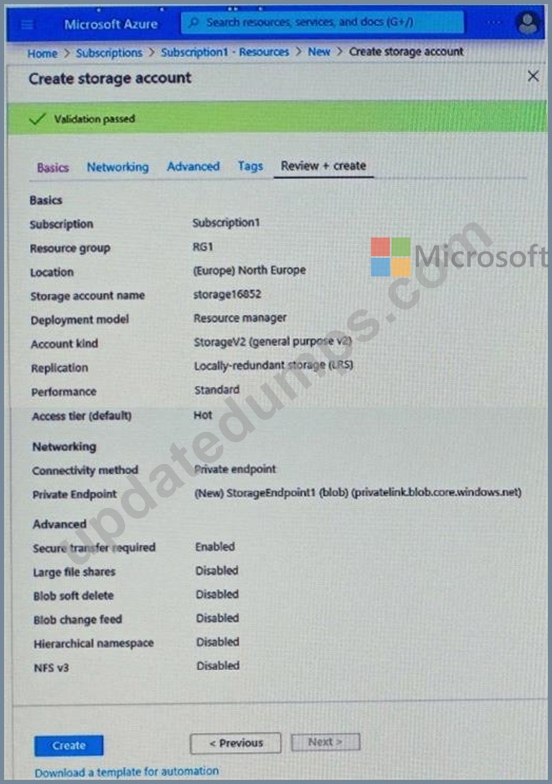
Use the drop-down menus to select the answer choice that completes each statement based on the information presented in the graphic.
NOTE: Each correct selection is worth one point.
Answer:
Explanation:
Reference:
https://azure.microsoft.com/en-in/pricing/calculator/?service=storage
NEW QUESTION # 144
You are troubleshooting a performance issue for an Azure Application Gateway.
You need to compare the total requests to the failed requests during the past six hours.
What should you use?
- A. Metrics in Application Gateway
- B. NSG flow logs in Azure Network Watcher
- C. Diagnostics logs in Application Gateway
- D. Connection monitor in Azure Network Watcher
Answer: A
Explanation:
Application Gateway currently has seven metrics to view performance counters.
Metrics are a feature for certain Azure resources where you can view performance counters in the portal. For Application Gateway, the following metrics are available:
Total Requests
Failed Requests
Current Connections
Healthy Host Count
Response Status
Throughput
Unhealthy Host count
You can filter on a per backend pool basis to show healthy/unhealthy hosts in a specific backend pool Reference:
Metrics
NEW QUESTION # 145
You have an Azure web app named App1 that has two deployment slots named Production and Staging. Each slot has the unique settings shown in the following table.
You perform a slot swap.
What are the configurations of the Production slot after the swap? To answer, select the appropriate options in the answer area.
NOTE: Each correction is worth one point.
Answer:
Explanation:
Which settings are swapped?
When you clone configuration from another deployment slot, the cloned configuration is editable. Some configuration elements follow the content across a swap (not slot specific), whereas other configuration elements stay in the same slot after a swap (slot specific). The following lists show the settings that change when you swap slots.
Box 1 : On
Settings that are swapped:
General settings, such as framework version, 32/64-bit, web sockets
App settings (can be configured to stick to a slot)
Connection strings (can be configured to stick to a slot)
Handler mappings
Public certificates
WebJobs content
Hybrid connections *
Virtual network integration *
Service endpoints *
Azure Content Delivery Network *
Features marked with an asterisk (*) are planned to be unswapped.
So web sockets settings will be swapped. So Production will have web sockets settings from "Off" to " On" after the swap slot.
Box 2: App1-prod.contoso.com
Settings that aren't swapped:
Publishing endpoints
Custom domain names
Non-public certificates and TLS/SSL settings
Scale settings
WebJobs schedulers
IP restrictions
Always On
Diagnostic settings
Cross-origin resource sharing (CORS)
So Custom domain names will not be swapped. So Production will have Custom domain names of its own after the swap slot.
Reference:
https://docs.microsoft.com/en-us/azure/app-service/deploy-staging-slots#what-happens-during-a-swap
NEW QUESTION # 146
You have an Azure subscription that contains an Azure Storage account named storage1 and the users shown in the following table.
You plan to monitor storage1 and to configure email notifications for the signals shown in the following table.
You need to identify the minimum number of alert rules and action groups required for the planned monitoring.
How many alert rules and action groups should you identify? To answer, select the appropriate options in the answer area.
NOTE: Each correct selection is worth one point.
Answer:
Explanation:
NEW QUESTION # 147
You have an Azure subscription that contains the resources in the following table.
Store1 contains a Tile share named data. Data contains 5,000 files.
You need to synchronize the files in the file share named data to an on-premises server named Server1.
Which three actions should you perform? Each correct answer presents part of the solution.
- A. Register Server1.
- B. Create a sync group.
- C. Create a container instance.
- D. Download an automation script.
- E. Install the Azure File Sync agent on Server1.
Answer: A,B,E
Explanation:
Step 1 (E): Install the Azure File Sync agent on Server1
The Azure File Sync agent is a downloadable package that enables Windows Server to be synced with an Azure file share Step 2 (D): Register Server1.
Register Windows Server with Storage Sync Service
Registering your Windows Server with a Storage Sync Service establishes a trust relationship between your server (or cluster) and the Storage Sync Service.
Step 3 (C): Create a sync group and a cloud endpoint.
A sync group defines the sync topology for a set of files. Endpoints within a sync group are kept in sync with each other. A sync group must contain one cloud endpoint, which represents an Azure file share and one or more server endpoints. A server endpoint represents a path on registered server.
References: https://docs.microsoft.com/en-us/azure/storage/files/storage-sync-files-deployment-guide
NEW QUESTION # 148
You have the App Service plan shown in the following exhibit.
The scale-in settings for the App Service plan are configured as shown in the following exhibit.

The scale out rule is configured with the same duration and cool down tile as the scale in rule.
Use the drop-down menus to select the answer choice that completes each statement based on the information presented in the graphic.
Answer:
Explanation:
NEW QUESTION # 149
You deploy an Azure Kubernetes Service (AKS) cluster that has the network profile shown in the following exhibit.
Use the drop-down menus to select the answer choice that completes each statement based on the information presented in the graphic.
NOTE: Each correct selection is worth one point.
Answer:
Explanation:
Box 1 : Containers will get the IP address from the virtual network subnet CIDr which is 10.244.0.0/16
Box 2 : Services in the AKS cluster will be assigned an IP address in the service CIDR which is 10.0.0.0/16
Reference:
https://docs.microsoft.com/en-us/azure/aks/configure-azure-cni
NEW QUESTION # 150
You have an Azure subscription that contains an Azure virtual machine named VM1. VM1 runs Windows Server 2016 and is part of an availability set.
VM1 has virtual machine-level backup enabled.
VM1 is deleted.
You need to restore VM1 from the backup. VM1 must be part of the availability set.
Which three actions should you perform in sequence? To answer, move the appropriate actions from the list of actions to the answer area and arrange them in the correct order.
Answer:
Explanation:
NEW QUESTION # 151
You plan to use Azure Network Watcher to perform the following tasks:
* Task1: Identify a security rule that prevents a network packet from reaching an Azure virtual machine
* Task2: Validate outbound connectivity from an Azure virtual machine to an external host Which feature should you use for each task? To answer, select the appropriate options in the answer area.
NOTE: Each correct selection is worth one point.
Answer:
Explanation:
Explanation
1: IP Flow verify
2: Connection troubleshoot
https://docs.microsoft.com/en-us/azure/network-watcher/network-watcher-monitoring-overview
NEW QUESTION # 152
You have an Azure App Service app named Appl that contains two running instances.
You havean autoscale rule configured as shown in the following exhibit
For the instance limits stale condition setting, you set Maximum to 5.
During a 30-minute period. Appl uses 60 percent of the available memory.
What is the maximum number of instances tor Appl during the 30-minute pefiod:
- A. 0
- B. 1
- C. 2
- D. 3
Answer: C
Explanation:
The exhibit shows that you have an autoscale rule configured for your App Service app named App1. The rule is based on the memory percentage metric, which measures the average amount of memory used by all the instances of your app. The rule has the following settings:
Scale out action: Add 1 instance when the memory percentage is greater than or equal to 80% for a duration of 10 minutes.
Scale in action: Remove 1 instance when the memory percentage is less than or equal to 60% for a duration of 10 minutes.
Instance limits: The minimum number of instances is 2, and the maximum number of instances is 5.
According to the question, during a 30-minute period, App1 uses 60% of the available memory. This means that the scale in action is triggered, but not the scale out action. Therefore, one instance is removed from App1 every 10 minutes, until the minimum number of instances is reached.
Since App1 initially has two running instances, after the first 10 minutes, one instance is removed and App1 has one instance left. However, since the minimum number of instances is set to 2, another instance is added back to App1 to meet the minimum requirement. Therefore, after the first 10 minutes, App1 still has two instances.
After the second 10 minutes, the same process repeats. One instance is removed due to the scale in action, and another instance is added back due to the minimum requirement. Therefore, after the second 10 minutes, App1 still has two instances.
After the third 10 minutes, there is no change in the number of instances, because App1 already has the minimum number of instances. Therefore, after the third 10 minutes, App1 still has two instances.
Therefore, during the 30-minute period, App1 never has more than two instances running at any given time. However, since one instance is removed and added back every 10 minutes, there are four different instances that are used by App1 during the period. Hence, the maximum number of instances for App1 during the period is four.
NEW QUESTION # 153
You have an Azure subscription named Subscription1. You have a virtualization environment that contains the virtualization server in the following table.
The virtual machines are configured as shown on the following table.
All the virtual machines use basic disks. VM1 is protected by using BitLocker Drive Encryption (BitLocker). You plan to use Azure Site Recovery to migrate the virtual machines to Azure.
Which virtual machines can you migrate? To answer, select the appropriate options in the answer area.
NOTE: Each correct selection is worth one point.
Answer:
Explanation:
Explanation:
Not VM1 because it has BitLocker enabled.
Not VM2 because the OS disk is larger than 2TB.
Not VMC because the Data disk is larger than 4TB.
References:
https://docs.microsoft.com/en-us/azure/site-recovery/hyper-v-azure-support-matrix#azure-vm-requirements
NEW QUESTION # 154
You have an Azure subscription named Subscription1 that contains the resources shown in the following table.
In storage1, you create a blob container named blob1 and a file share named share1.
Which resources can be backed up to Vault1 and Vault2? To answer, select the appropriate options in the answer area.
NOTE: Each correct selection is worth one point.
Answer:
Explanation:
Explanation:
Box 1: VM1 only
VM1 is in the same region as Vault1.
File1 is not in the same region as Vautl1.
SQL is not in the same region as Vault1.
Blobs cannot be backup up to service vaults.
Note: To create a vault to protect virtual machines, the vault must be in the same region as the virtual machines.
Box 2: Share1 only.
Storage1 is in the same region (West USA) as Vault2. Share1 is in Storage1.
Note: After you select Backup, the Backup pane opens and prompts you to select a storage account from a list of discovered supported storage accounts. They're either associated with this vault or present in the same region as the vault, but not yet associated to any Recovery Services vault.
References:
https://docs.microsoft.com/bs-cyrl-ba/azure/backup/backup-create-rs-vault
https://docs.microsoft.com/en-us/azure/backup/backup-afs
Topic 1, Litware, inc.
Overview
Litware, Ltd. is a consulting company that has a main office in Montreal and two branch offices in Seattle and New York.
The Montreal office has 2,000 employees. The Seattle office has 1,000 employees. The New York office has 200 employees.
All the resources used by Litware are hosted on-premises.
Litware creates a new Azure subscription. The Azure Active Directory (Azure AD) tenant uses a domain named Litware.onmicrosoft.com. The tenant uses the P1 pricing tier.
Existing Environment
The network contains an Active Directory forest named Litware.com. All domain controllers are configured as DNS servers and host the Litware.com DNS zone.
Litware has finance, human resources, sales, research, and information technology departments. Each department has an organizational unit (OU) that contains all the accounts of that respective department. All the user accounts have the department attribute set to their respective department. New users are added frequently.
Litware.com contains a user named User1.
All the offices connect by using private links.
Litware has data centers in the Montreal and Seattle offices. Each data center has a firewall that can be configured as a VPN device.
All infrastructure servers are virtualized. The virtualization environment contains the servers in the following table.
Litware uses two web applications named App1 and App2. Each instance on each web application requires 1GB of memory.
The Azure subscription contains the resources in the following table.
The network security team implements several network security groups (NSGs).
Planned Changes
Litware plans to implement the following changes:
* Deploy Azure ExpressRoute to the Montreal office.
* Migrate the virtual machines hosted on Server1 and Server2 to Azure.
* Synchronize on-premises Active Directory to Azure Active Directory (Azure AD).
* Migrate App1 and App2 to two Azure web apps named webApp1 and WebApp2.
Technical Requirements
Litware must meet the following technical requirements:
* Ensure that WebApp1 can adjust the number of instances automatically based on the load and can scale up to five instance*.
* Ensure that VM3 can establish outbound connections over TCP port 8080 to the applications servers in the Montreal office.
* Ensure that routing information is exchanged automatically between Azure and the routers in the Montreal office.
* Enable Azure Multi-Factor Authentication (MFA) for the users in the finance department only.
* Ensure that webapp2.azurewebsites.net can be accessed by using the name app2.Litware.com.
* Connect the New Your office to VNet1 over the Internet by using an encrypted connection.
* Create a workflow to send an email message when the settings of VM4 are modified.
* Create a custom Azure role named Role1 that is based on the Reader role.
* Minimize costs whenever possible.
NEW QUESTION # 155
Note: This question is part of a series of questions that present the same scenario. Each question in the series contains a unique solution that might meet the stated goals. Some question sets might have more than one correct solution, while others might not have a correct solution.
After you answer a question in this section, you will NOT be able to return to it. As a result, these questions will not appear in the review screen.
You have an Azure virtual machine named VM1 that runs Windows Server 2016.
You need to create an alert in Azure when more than two error events are logged to the System event log on VM1 within an hour.
Solution: You create an Azure Log Analytics workspace and configure the data settings. You install the Microsoft Monitoring Agent on VM1. You create an alert in Azure Monitor and specify the Log Analytics workspace as the source.
Does this meet the goal?
- A. No
- B. Yes
Answer: B
Explanation:
Section: [none]
Explanation:
Alerts in Azure Monitor can identify important information in your Log Analytics repository. They are created by alert rules that automatically run log searches at regular intervals, and if results of the log search match particular criteria, then an alert record is created and it can be configured to perform an automated response.
The Log Analytics agent collects monitoring data from the guest operating system and workloads of virtual machines in Azure, other cloud providers, and on-premises. It collects data into a Log Analytics workspace.
Reference:
https://docs.microsoft.com/en-us/azure/azure-monitor/learn/tutorial-response
https://docs.microsoft.com/en-us/azure/azure-monitor/platform/agents-overview
NEW QUESTION # 156
Note: This question is part of a series of questions that present the same scenario. Each question in the series contains a unique solution that might meet the stated goals. Some question sets might have more than one correct solution, while others might not have a correct solution.
After you answer a question in this section, you will NOT be able to return to it. As a result, these questions will not appear in the review screen.
You manage a virtual network named VNet1 that is hosted in the West US Azure region.
VNet1 hosts two virtual machines named VM1 and VM2 that run Windows Server.
You need to inspect all the network traffic from VM1 to VM2 for a period of three hours.
Solution: From Performance Monitor, you create a Data Collector Set (DCS).
Does this meet the goal?
- A. No
- B. Yes
Answer: A
Explanation:
Explanation
You should use Azure Network Watcher.
References:
https://docs.microsoft.com/en-us/azure/network-watcher/network-watcher-monitoring-overview
NEW QUESTION # 157
Note: This question is part of a series of questions that present the same scenario. Each question in the series contains a unique solution that might meet the stated goals. Some question sets might have more than one correct solution, while others might not have a correct solution.
After you answer a question in this section, you will NOT be able to return to it. As a result, these questions will not appear in the review screen.
You have an Azure Directory (Azure AD) tenant named Adatum and an Azure Subscription named Subscription1. Adatum contains a group named Developers. Subscription1 contains a resource group named Dev.
You need to provide the Developers group with the ability to create Azure logic apps in the Dev resource group.
Solution: On Dev, you assign the Contributor role to the Developers group.
Does this meet the goal?
- A. No
- B. Yes
Answer: B
Explanation:
Section: [none]
Explanation:
The Contributor role can manage all resources (and add resources) in a Resource Group.
NEW QUESTION # 158
This question is part of a series of questions that present the same scenario. Each question in the series contains a unique solution that might meet the stated goals. Some question sets might have more than one correct solution, while others might not have a correct solution.
After you answer a question in this section, you will NOT be able to return to it. As a result, these questions will not appear in the review screen.
You have an Azure subscription named Subscription1 that contains the resources shown in the following table.
VM1 connects to a virtual network named VNET2 by using a network interface named NIC1.
You need to create a new network interface named NIC2 for VM1.
Solution: You create NIC2 in RG1 and Central US.
Does this meet the goal?
- A. No
- B. Yes
Answer: A
Explanation:
The virtual machine you attach a network interface to and the virtual network you connect it to must exist in the same location, here West US, also referred to as a region.
Reference:
https://docs.microsoft.com/en-us/azure/virtual-network/virtual-network-network-interface
NEW QUESTION # 159
You have a sync group named Sync1 that has a cloud endpoint. The cloud endpoint includes a file named File1.txt.
You on-premises network contains servers that run Windows Server 2016. The servers are configured as shown in the following table.
You add Share1 as an endpoint for Sync1. One hour later, you add Share2 as an endpoint for Sync1.
For each of the following statements, select Yes if the statement is true. Otherwise, select No.
NOTE: Each correct selection is worth one point.
Answer:
Explanation:
Reference:
https://docs.microsoft.com/en-us/azure/storage/files/storage-sync-files-planning
http://techgenix.com/azure-file-sync-replicating-data/
NEW QUESTION # 160
......
Microsoft AZ-104 exam is designed for individuals who want to become certified Azure administrators. AZ-104 exam measures the candidate's knowledge and skills in managing Azure resources, implementing and managing storage solutions, configuring and managing virtual networks, and managing Azure identities and governance. It is intended for individuals who have experience working with Azure services and have a fundamental understanding of cloud computing concepts.
AZ-104 Dumps for Microsoft Azure Administrator Associate Certified Exam Questions and Answer: https://actualtest.updatedumps.com/Microsoft/AZ-104-updated-exam-dumps.html